

Meet the Major: Theatre with Kerrigan Sullivan
For Kerrigan Sullivan, it started with a magic moment. She was about five years old when her mom took her to see a play. Sullivan remembers being completely swept up in the experience. By six, she had landed her first role. Today, as a professor of theatre and chair of Brightpoint’s Department of Performing Arts, she helps students create those magic moments for others.
Kerrigan Sullivan is a professor of theatre and chair of the Department of Performing Arts at Brightpoint Community College, where she leads the college’s theatre programs and directs productions in The Lynn Theatre. An accomplished director and theatre artist, Sullivan has helped champion the development of new theatrical works through The Lynn Theatre’s Studio Series, directing productions including Jump Baby, WillJee and small quiet good. She is also active in the local professional theatre community and is the Community College Theatre Alliance representative for the Association for Theatre in Higher Education, extending her commitment to theatre education through national conversations around teaching, transfer pathways and community college theatre programs.
Q: What’s one thing students get to do in this program that’s much more interesting than the course title makes it sound?
Sullivan: There’s a course called Theatre Workshop, which is our production course. Students get to work on shows and participate in every aspect of a production.
There’s a section for performers and a section for technicians. We also sometimes have students working as stage managers or assistant directors. Students work alongside professionals because the members of my staff are professional theatre artists. The staff designs the show, and the students help execute those designs backstage.
Performance majors audition for and act in the shows. The productions might include a play, a musical or a new work. Each year, we produce one straight play, one musical and one new play.
Students can sign up for the class and work in different areas of production. It’s so much more than the title “Theatre Workshop” suggests. It’s literally everything.
Q: What’s something about your field that most people would be surprised to learn?
Sullivan: There are so many parts of theatre that are less visible. Most people are familiar with seeing performers or actors, but they don’t realize how much work goes into creating those moments.
That’s true in many artistic fields. You see the finished product, but you don’t see the hours spent creating it. If you worked on a show and saw how much time goes into it, you would probably be surprised. We make it look easy because we rehearse, practice, hone our craft and do a tremendous amount of work behind the scenes.
The technical side of theatre is also a fascinating world. We frequently have production meetings where we talk about the “magic moments” in a show. Those moments are often created through technical elements.
In one of the new plays we produced this past summer, our favorite magic moment happened at the very end. We used a kabuki drop and a star drop. A scrim at the front of the stage dropped to reveal the star drop behind it. The back of the theatre seemed to disappear, and suddenly the audience saw this huge expanse of stars.
Along with what the performers were doing, we used surround sound featuring an original composition created for the show. The lighting extended the stars beyond the stage and over the entire audience.
That brief moment required a tremendous amount of work. It was worth it because we consistently heard the audience gasp, which is exactly what you want. We want people to feel something.The moment may have lasted only 10 seconds, but people probably wouldn’t realize how many hours went into creating it. Programming the lights, operating the drop and coordinating all the elements required a great deal of work.
The moment may have lasted only 10 seconds, but people probably wouldn’t realize how many hours went into creating it. Programming the lights, operating the drop and coordinating all the elements required a great deal of work.


Q: What first made you interested in this field?
Sullivan: When I was about five years old, my mom took me to a show. It was a version of The Hobbit that included fairies and other magical elements. My mind was completely blown. I was caught up in the magic of it.
Afterward, I met the actors and thought, “This is what I want to do.” I kept asking my mom to take me to the theatre’s next audition. When I was six, I was cast in my first role as the littlest blind girl in The Miracle Worker. Somewhere, I still have a picture of it.
That was essentially it for me. I had performed in more than 100 shows by the time I reached high school. The experience hooked me, and theatre was all I ever wanted to do, although my role within the field has taken different forms over the years.
That early experience is also why hearing an audience gasp during one of our shows means so much to me. Those reactions remind me why I will always stay connected to this work.
Q: What do you hope students start noticing or seeing differently after taking one of your classes?
Sullivan: Many students come in understanding only the tip of the iceberg when it comes to theatre, the performing arts and the arts more broadly. Some have a great deal of experience, while others have almost none.
I hope they leave with a deeper understanding of the craft and the skills required to do this work. I also want them to understand the enormous ripple effect the arts can have in our lives.
I frequently tell students that everyone’s path will be different. Regardless of where they go or what career they pursue, they can always keep the arts in their lives in some way. The arts can add so much richness, whether or not they become a person’s primary career.
Sharing the arts with others also creates a communal experience. There is something deeply human about it. It is something we need.
Students may arrive with certain ideas about acting or technical theatre. I hope they leave with a much deeper understanding of what it takes to work in the arts and what the arts contribute to society.
As a society, we are doing a great deal with artificial intelligence and other new technologies. Those innovations can be valuable, but we also desperately need a counterbalance. We are not complete human beings if we are not engaging our creativity and using both sides of our brains.
Q: What skills do students develop here that they may not realize employers or four-year colleges are looking for?
Sullivan: These skills have often been called “soft skills,” but whatever term you use, they are among the most important things students take away from the program.
Students learn how to work with others toward a common goal. They learn to articulate and communicate a vision for a project. They also learn how to contribute their own ideas while allowing those ideas to be changed or strengthened by other people.
In improvisation, we use the concept of “yes, and.” One person presents an idea, someone else accepts it and adds to it, and the group continues building together.
Listening to and accepting other people’s ideas is extremely valuable. Students learn not to remain fixed in the belief that everything must go their way. They learn to work in community, contribute to a project and allow their contributions to be shaped by others.
Problem-solving is also a huge part of the program because creative problem-solving is what we do all day long. Students must think critically, examine a situation and consider alternative approaches.
We may enter a space with a plan and discover that something isn’t working, looks different than expected or needs to be adjusted. We then find a way to make it work. That process develops grit, resilience, intuition and the ability to keep pushing through challenges.
Students learn how to work with others toward a common goal. They learn to articulate and communicate a vision for a project. They also learn how to contribute their own ideas while allowing those ideas to be changed or strengthened by other people.


Q: What are some careers connected with this major that students might not immediately think of?
Sullivan: There are many possibilities, and the applications can be extremely broad. The skills students learn in technical theatre can now be applied to almost any industry. Skills involving audiovisual technology, sound and the creation of physical or digital spaces are needed by many companies. Because we live in such a digital society, someone with that skill set can work almost anywhere.
There are many opportunities within theatres, but the skills are also valuable outside of traditional theatre settings. For example, casinos and other entertainment venues coming into the area may need employees with technical theatre experience. That could create a direct employment pipeline for our students.
The skills students develop as performers also transfer into many different careers. In the age of artificial intelligence, there has been renewed interest among employers in people with philosophy and arts degrees because those graduates know how to think. The ability to think critically is extremely important.
There are also many arts-adjacent careers, including marketing, creative advertising and education. The tools and technology students learn have very broad applications.
Video is now used almost everywhere. A student may produce video, perform on camera or contribute in another capacity. The performance and production skills learned in these classes can be applied to many circumstances. They are not limited to performing a traditional play script.
Q: Tell us about a student experience in this program that has stayed with you.
Sullivan: There are so many. My favorite thing is seeing students succeed in ways that are meaningful to them. I have former students who have gone on to work in places such as London, New York, Chicago and Florida. I also love seeing students return and contribute to the local arts community.
One of my favorite examples is Alleigh Scantling. She began as a student here and later transferred to Manchester, where she earned a theatre degree. She worked in several different roles afterward, and life took her in different directions. When I opened this theatre, she was the first person I contacted about coming back to help me run it. She worked here until last year. She is now the technical director at the Perkinson Center for the Arts and helps run the technical side of that nonprofit organization.
Hailey Bean, our shop supervisor, was also a student here. She transferred to Longwood, earned her degree and returned. She now runs the shop and teaches the technical theatre class.
I love keeping former students here when I can, but I also support them when it is time for them to leave and pursue other opportunities. It is especially rewarding when they eventually come back.
Many of our students overcome significant challenges to be here. In the arts, it sometimes takes people longer to reach where they want to go. Seeing them persevere and achieve success is the best part of this work.
Several recent graduates are now at Virginia Commonwealth University, and they have already told me they plan to come back afterward. I tell them, “Yes, you are.”
Q: What’s something your students have taught you?
Sullivan: I learn from my students every day. That is one of the things I love about being an educator.
As I get older and begin to see things differently, the next generation constantly reminds me to consider new perspectives. When you are willing to remain open and listen without judgment—rather than saying, “That’s not the way we did it”—there are so many things that can change the way you see things.
Learn more about upcoming shows students are working on in the Lynn Theatre and studying arts and communications at Brightpoint.
This interview took place September 3, 2026. It is a part of the new Meet the Major digital series featuring the people who drive Brightpoint's academic programs and are shaping the future of our region's workforce.
Related News
View All News-
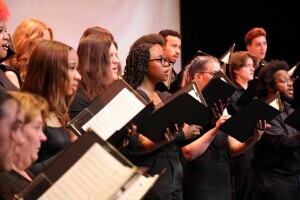

What does it take to turn a love of music into something more? At Brightpoint Community College, students are discovering that studying music is about more than learning notes and performing on stage. It takes dedication, creativity and a willingness to grow. In this edition of Meet the Major, Dr. David Guthrie, professor of music and head of Brightpoint's music program, shares how his lifelong passion for music shaped his career, the moments that make teaching rewarding and how Brightpoint helps students build a foundation for their next steps in music.
-
-


Whether you’re starting fresh or keeping your momentum going, there’s still time to sign up for fall classes kicking off on October 19 at Brightpoint. Our second 7-week session gives you a simple way to keep moving forward before the end of the year.
-