Skip to main content Skip to site alert
Brightpoint

Secondary

  • About
  • Locations & Tours
  • Alerts

Actions

  • myBrightpoint
  • Apply Now
  • Give to Brightpoint

Resources for…

  • Future Students
  • Current Students
  • Alumni
  • Donors
  • Faculty & Staff

Main

  • Admissions
    • Get Started
    • Tour Brightpoint
    • Request Information
    • Information Sessions
    • Orientation
    • Majors
    • High School and Homeschool Programs
    • International Students
    • Military & Veterans Educational Benefits
    • Great Expectations
    • Admissions & Records
  • Academics & Programs
    • Majors
    • Career Clusters
    • Declaring a Major
    • Beginning Coursework
    • Academic Support
    • Transfer
    • Online Learning
    • Division Offices
    • Exam Schedule
    • Class Schedule
    • Academic Calendar
    • Catalog & Student Handbook
    • Educational Travel
    • Drop, Withdraw, Request to Repeat
  • Training & Workforce
    • Brightpoint: Good for Business
    • Career Training Programs
    • CCWA
    • G3 Program
  • Paying for Brightpoint
    • Tuition and Fees
    • Pay Your Tuition
    • Financial Aid
    • Cashier's Office
    • Brightpoint Scholarships
  • Services
    • Admissions & Records
    • Advising
    • Bookstore
    • Career Services
    • Food Services
    • Graduation
    • Help Hub
    • Library
    • Military & Veterans Education Office
    • Student Accessibility Services
    • Student Activities
    • Student Support
    • Technology Support
    • Testing Center
    • Tutoring in the ARC
Menu  Close 

You are here:

  1. Home
  2. About Brightpoint
  3. Office of Institutional Effectiveness
  4. Event

Student Achievement Data

About Navigation

  • Fast Facts
  • Locations
  • Leadership
  • Directory
  • Data Dashboards
  • Student Achievement Data
  • Office of Institutional Effectiveness
  • Center for Teaching and Learning
  • Human Resources
  • Dean of Students Office
  • Creative Services and Public Relations
  • Brightpoint A-Z
  • Employment Opportunities
  • Brightpoint Community College Foundation
  • Accreditation
  • Safety and Security
  • News
  • Calendar
  • Mission, Vision and Values
  • Sustainability
  • Health and Safety
  • Virtual Tours
  • Featured Events
  • Legislative Advocacy

In coordination with the Virginia Community College System (VCCS) and the Southern Association of Colleges and Schools Commission on Colleges (SACSCOC), Brightpoint Community College, formerly John Tyler Community College, uses multiple measures as “indicators of student achievement identified by the institution itself given its mission, student population, programs, resources, and strategic priorities” (CR 8.1 Student Achievement, 2019 SACSCOC Institute on Quality Enhancement and Accreditation, Dallas, TX).

Our institutional mission is a broad series of statements that encompass our mission statement, vision statement and diversity statement. 

Brightpoint's collegewide strategic plan, Trailblazing Opportunities 2030, is based on the Virginia Community College System's Accelerate Opportunity: 2024-2030 Statewide Strategic Plan.

Our goals for Trailblazing Opportunities 2030 are: 

1. Student Success

Prepare students with the knowledge, skills, credentials, and degrees to become successful in dynamic, high-demand, and emerging careers.

2. Forging the Path

Cultivate connections and develop ways to expand the talent pipeline in our service region.

3. Serving Today’s Learners

Deliver premier educational offerings to today’s learners, and promote professional excellence and high-impact instructional practices.

4. Culture of Care

Support the diverse needs of our students through a culture of care.

5. Affordable Access and Sustainability

Invest in improving access to an affordable college education for our students while supporting the vitality and sustainability of our college. 

Student Achievement Metrics

Our institutional strategic plan outlines our institutional commitment to four strategic focus areas:  student equity, funding and finance solutions, pathways to success, and process and practice innovation.  To measure student achievement, our college has identified the following metrics, targets or goals, and thresholds of acceptability listed below.

Institutional Learning Outcomes (ILOs) Assessment

In addition to our student achievement metrics, our college measures general education requirements using the following institutional learning outcomes (ILOs) in embedded class assessments.  Our ILOs are aligned to Virginia Community College System (VCCS) Policy 5.0.2 General Education and State Council of Higher Education for Virginia (SCHEV) Outcomes Assessment policies, and are reflective of our institutional mission, vision, college goals, and academic programs --

  • Civic Engagement
  • Critical Thinking
  • Professional Readiness
  • Quantitative Literacy
  • Scientific Literacy
  • Written Communication

Our target performance level for our ILOs is 70% of students will achieve a score of 70 or higher on in-class assessments.  Under each ILO listed above is a description of the VCCS definition, ILO, and subdomains under the outcome, and a graph tracking our progress.  We reported our progress to SCHEV, as well as our continuous quality improvements in outcomes assessment, in more detail, in our 2018-2020 Report on Assessment of Learning and Quality.
  • Civic engagement is the ability to contribute to the civic life and well-being of local, national, and global communities as both as social responsibility and a life-long learning process. Degree graduates will demonstrate the knowledge and civic values necessary to become informed and contributing participants in a democratic society.

    ILO:  Demonstrate the knowledge and civic values necessary to become informed and contributing participants in a democratic society (Civic Engagement).

    • Civic Knowledge: Summarize fundamental principles and debates about democracy and citizenship, both within the United States and in other countries. 
    • Civic Identity: Reflect on personal social/civic identity and how that identity differs from others in their communities. 
    • Civic Discourse: Deliberate on issues and problems to advance or achieve a civic aim.  
    • Diversity in Civic Life: Recognize the value of diverse feelings, perspectives, and life experiences, and the strength that such diversity brings to civic life.  
    • Ethical Reasoning: Examine the ethical implications of community and civic actions and decisions.  
    • Civic Responsibility: Consider and respond to civic, social, environmental, or economic challenges at local, national, or global levels.  
    • Social Justice: Identify personal and collective actions that could be taken to address injustices in society.    


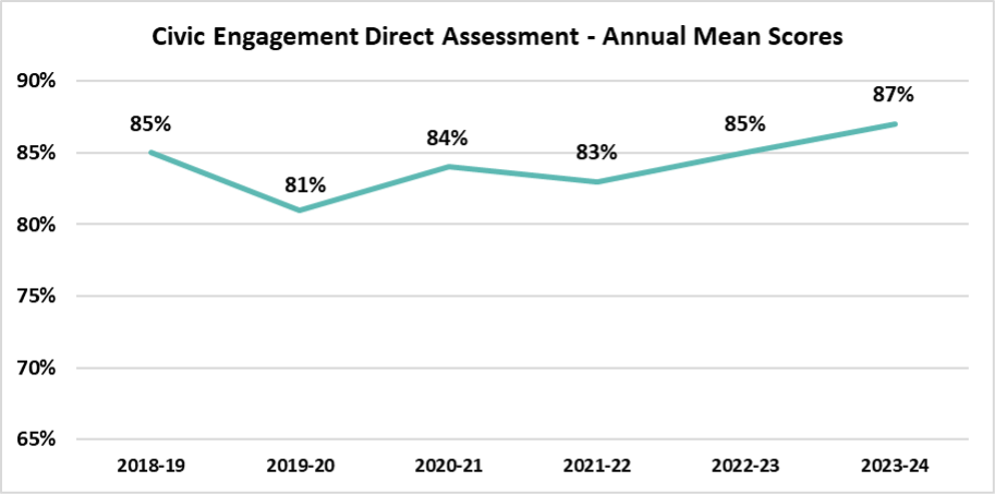
    The following chart shows the Civic Engagement Direct Assessment Mean Scores over the past six academic years. The chart ranges from 65% to 90% vertically, reflecting the average scores across all student assessments over an academic year. Horizontally, the chart ranges from 2018-19 to 2023-24 and the actual mean scores were 85% for 2018-19, 81% for 2019-20, 84% for 2020-21, 83% for 2021-22, 85% for 2022-23, and 87% for 2023-24.

    Civic Engagement Chart

  • Critical thinking is the ability to use information, ideas and arguments from relevant perspectives to make sense of complex issues and solve problems. Degree graduates will locate, evaluate, interpret, and combine information to reach well-reasoned conclusions or solutions.

    ILO:  Locate, evaluate, interpret, and combine information, to reach well-reasoned conclusions or solutions (Critical Thinking).

    Analytic Skills:  

    • Evaluate evidence, arguments, and its use,  
    • Demonstrate an understanding of the language of argumentation and recognize linguistic cues, and  
    • Distinguish between valid and invalid arguments. 

    Synthetic Skills:  

    • Demonstrate an understanding of implications and consequences, and  
    • Develop arguments that are valid and sound.

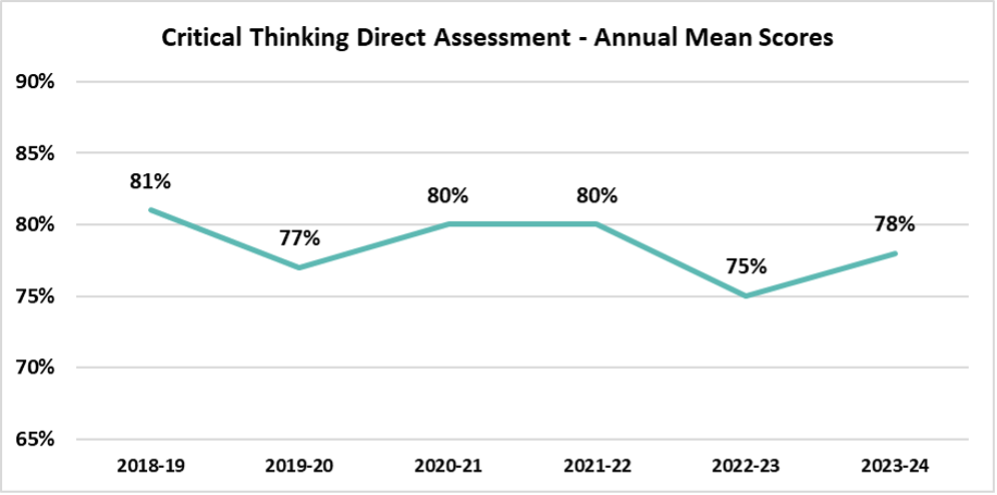
    The following chart shows the Critical Thinking Direct Assessment Mean Scores over the past six academic years. The chart ranges from 65% to 90% vertically, reflecting the average scores across all student assessments over an academic year. Horizontally, the chart ranges from 2018-19 to 2023-24 and the actual mean scores were 81% for 2018-19, 77% for 2019-20, 80% for 2020-21, 80% for 2021-22, 75% for 2022-23, and 78% for 2023-24.

    Critical Thinking Chart

  • Professional readiness is the ability to work well with others and display situationally and culturally appropriate demeanor and behavior. Degree graduates will demonstrate skills important for successful transition into the workplace and pursuit of further education. 

    ILO:  Demonstrate skills important for successful transition into the workplace and pursuit of further education (Professional Readiness).

    • Interpersonal Communication: Maintain open, effective, and professional communications.  
    • Workplace Demeanor: Demonstrate appropriate workplace and classroom demeanor and behavior.   
    • Teamwork: Work effectively with others on a task in a group or a team to achieve a common goal while maintaining constructive interpersonal relationships 
    • Creative Problem-Solving: Solve a challenge or program through innovative ways   
    • Ethical Reasoning: Demonstrate the ability to assess the reasoning of an argument, recognize and/or apply ethical perspectives to ethical dilemmas, and consider the ramifications of alternative actions. 
    • Ethical Values:  Demonstrate the ability to assess what one considers to be morally important or beneficial within the context of a problem and/or within a variety of settings. 
    • Leadership:  Discern and describe personal leadership style, strengths, and limitations.   
    • Cultural Awareness:  Recognize one’s own multiple identities, experiences, and biases, and how these affect one’s ability to lead, perceive, and/or interact with others. 

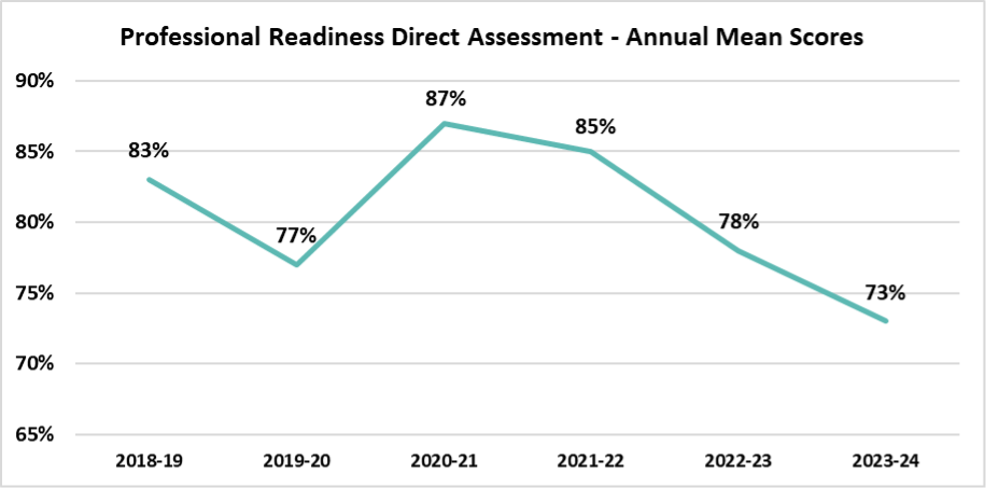
    The following chart shows the Professional Readiness Direct Assessment Mean Scores over the past six academic years. The chart ranges from 65% to 90% vertically, reflecting the average scores across all student assessments over an academic year. Horizontally, the chart ranges from 2018-19 to 2023-24 and the actual mean scores were 83% for 2018-19, 77% for 2019-20, 87% for 2020-21, 85% for 2021-22, 78% for 2022-23, and 73% for 2023-24.

    Professional Readiness

  • Quantitative literacy is the ability to perform accurate calculations, interpret quantitative information, apply and analyze relevant numerical data, and use results to support conclusions. Degree graduates will calculate, interpret, and use numerical and quantitative information in a variety of settings. 

    ILO:  Calculate, interpret, and/or use numerical and quantitative information in a variety of settings (Quantitative Literacy).

    • Interpretation:  Identify and/or explain mathematical information, data, graphs; this may include drawing conclusions and/or recognizing sources of error.   
    • Representation:  Convert information into various mathematical forms (e.g., equations, graphs, diagrams, tables, words). 
    • Modeling:  Describe assumptions or recognize relationships in the environment or in mathematical forms, or express model(s) in one or more mathematical representations.   
    • Communication:  Present symbolic and/or numerical concepts and ideas (e.g., mathematical arguments or models). 
    • Calculation:  Provide accurate solutions to problems, using symbolic and/or numerical information. 

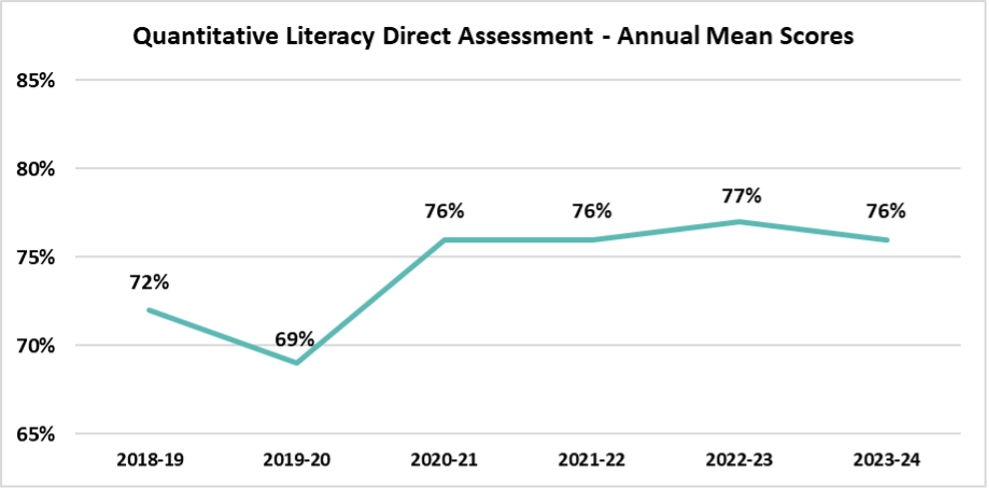
    The following chart shows the Quantitative Literacy Direct Assessment Mean Scores over the past six academic years. The chart ranges from 65% to 85% vertically, reflecting the average scores across all student assessments over an academic year. Horizontally, the chart ranges from 2018-19 to 2023-24 and the actual mean scores were 72% for 2018-19, 69% for 2019-20, 76% for 2020-21, 76% for 2021-22, 77% for 2022-23, and 76% for 2023-24.

    Quantitative Literacy

  • Scientific literacy is the ability to apply the scientific method and related concepts and principles to make informed decisions and engage with issues related to the natural, physical, and social world. Degree graduates will recognize and know how to us the scientific method, and to evaluate empirical information. 

    ILO:  Recognize and know how to use the scientific method, and to evaluate empirical information (Scientific Literacy).

    • Method of Inquiry: Recognize the steps of the scientific method of inquiry leading to evidence-based knowledge. 
    • Empirical Evidence:  Use theories, reasoning, and/or models as unifying principles of natural phenomena and/or to draw evidence-based conclusions. 
    • Societal Influences:  Recognize the interdependence of applied research, theoretical research, and technology, and how they impact society. 
    • Ethical Implications:  Demonstrate an understanding of the interdependence between developments in science or technology, and ethical issues. 
    • Scientific Argument:  Distinguish a scientific argument from a non-scientific argument. 

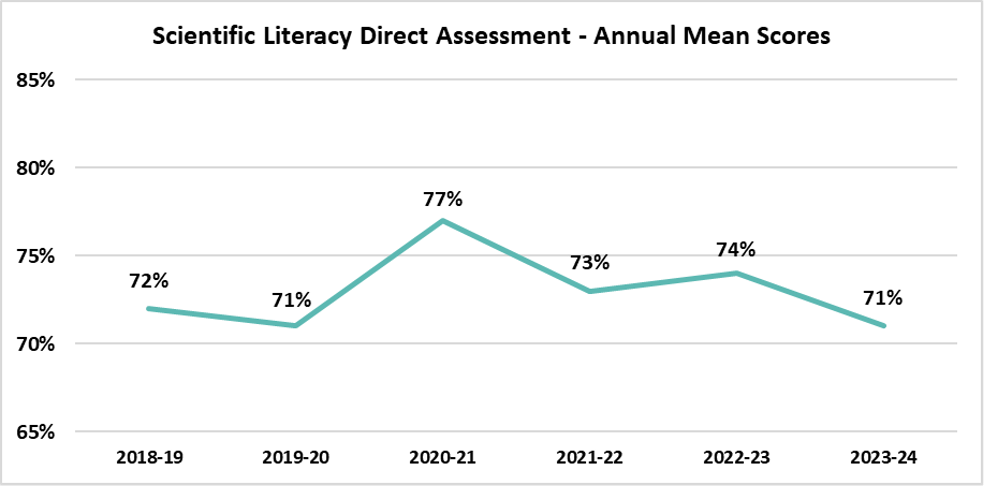
    The following chart shows the Scientific Literacy Direct Assessment Mean Scores over the past six academic years. The chart ranges from 65% to 85% vertically, reflecting the average scores across all student assessments over an academic year. Horizontally, the chart ranges from 2018-19 to 2023-24 and the actual mean scores were 72% for 2018-19, 71% for 2019-20, 77% for 2020-21, 73% for 2021-22, 74% for 2022-23, and 71% for 2023-24.

    Scientific Literacy Chart

  • Written communication is the ability to develop, convey, and exchange ideas in writing, as appropriate to a given context and audience. Degree graduates will express themselves effectively in a variety of written forms. 

    ILO:  Express oneself effectively by developing, conveying, and/or exchanging ideas in writing, as appropriate to a given context and audience (Written Communication). 

    • Context and Purpose: Present the topic with respect to the intended audience, setting, and objective. 
    • Content Development: Show an understanding of the subject matter through use of appropriate, relevant, and compelling writing. 
    • Genre and Disciplinary Conventions:  Demonstrate appropriate use of organization, content, presentation, formatting, and stylistic choices. 
    • Sources and Evidence:  Apply high-quality, credible, and relevant sources to develop and communicate ideas appropriate to the goal and genre. 
    • Syntax and Mechanics:  Use language that communicates meaning to readers with clarity and fluency, with few or no errors.

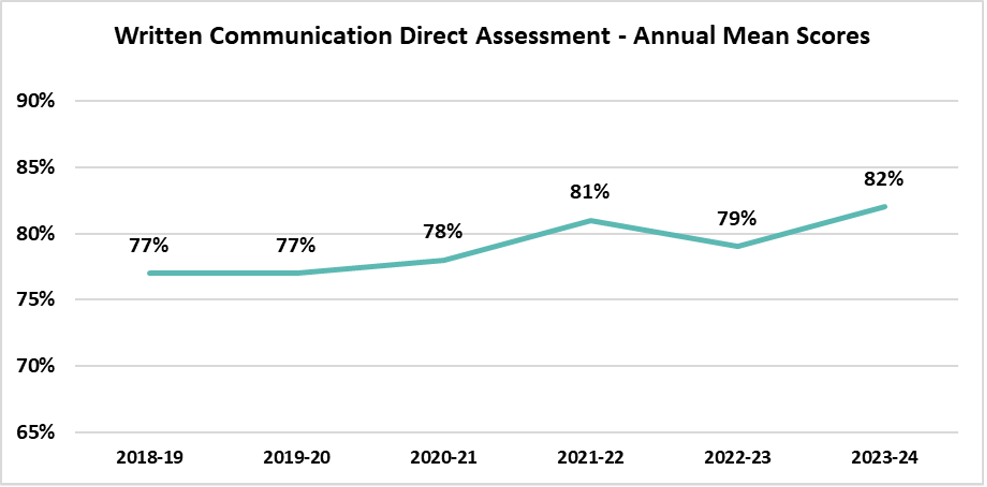
    The following chart shows the Written Communication Direct Assessment Mean Scores over the past six academic years. The chart ranges from 65% to 90% vertically, reflecting the average scores across all student assessments over an academic year. Horizontally, the chart ranges from 2018-19 to 2023-24 and the actual mean scores were 77% for 2018-19, 77% for 2019-20, 78% for 2020-21, 81% for 2021-22, 79% in 2022-23, and 82% for 2023-24.

    Written Communication

IPEDS New Outcomes Measure

Disaggregated Results - IPEDS New Outcomes Measure, 8-Year Component

  FTIC Non-FTIC
Minimum Threshold (%) Full-time Part-time Full-time Part-time
Pell 29 13 25 13
Non-Pell 37 18 36 20
 
Goal (%)        
Pell 25 13 25 20
Non-Pell 35 20 35 23


If you have any questions regarding the data on this webpage, please contact the Office of Institutional Effectiveness.

Brightpoint
Chester Campus
13101 Route 1 (Formerly Jefferson Davis Highway) Chester, Virginia 23831-5316
Phone 804-796-4000
Phone 800-552-3490
TDD 804-796-4197 - TDD
Midlothian Campus
800 Charter Colony Parkway Midlothian, Virginia 23114-4383
Phone 804-796-4000
Phone 800-552-3490
TDD 804-796-4197 - TDD

Footer

  • Help Hub
  • Nondiscrimination Statement
  • Directory
  • Privacy/Disclaimer
  • Photography Statement
  • Public Records
  • Brightpoint A-Z

Auxilary

  • FOIA
  • Employment at Brightpoint
  • VCCS

Social

  • Facebook
  • Instagram
  • Linkedin
  • Youtube
  • X

Auxilary

  • FOIA
  • Employment at Brightpoint
  • VCCS

© 2025

Site Menu

Site

  • Admissions
    • Get Started
    • Tour Brightpoint
    • Request Information
    • Information Sessions
    • Orientation
    • Majors
    • High School and Homeschool Programs
    • International Students
    • Military & Veterans Educational Benefits
    • Great Expectations
    • Admissions & Records
  • Academics & Programs
    • Majors
    • Career Clusters
    • Declaring a Major
    • Beginning Coursework
    • Academic Support
    • Transfer
    • Online Learning
    • Division Offices
    • Exam Schedule
    • Class Schedule
    • Academic Calendar
    • Catalog & Student Handbook
    • Educational Travel
    • Drop, Withdraw, Request to Repeat
  • Training & Workforce
    • Brightpoint: Good for Business
    • Career Training Programs
    • CCWA
    • G3 Program
  • Paying for Brightpoint
    • Tuition and Fees
    • Pay Your Tuition
    • Financial Aid
    • Cashier's Office
    • Brightpoint Scholarships
  • Services
    • Admissions & Records
    • Advising
    • Bookstore
    • Career Services
    • Food Services
    • Graduation
    • Help Hub
    • Library
    • Military & Veterans Education Office
    • Student Accessibility Services
    • Student Activities
    • Student Support
    • Technology Support
    • Testing Center
    • Tutoring in the ARC

Actions

  • myBrightpoint
  • Apply Now
  • Give to Brightpoint

Resources for…

  • Future Students
  • Current Students
  • Alumni
  • Donors
  • Faculty & Staff

Secondary

  • About
  • Locations & Tours
  • Alerts